

Alignment & Execution

Policy Deployment (or Hoshin Kanri) is a Japanese management process that can really help with the alignment of the teams, as illustrated by this example.
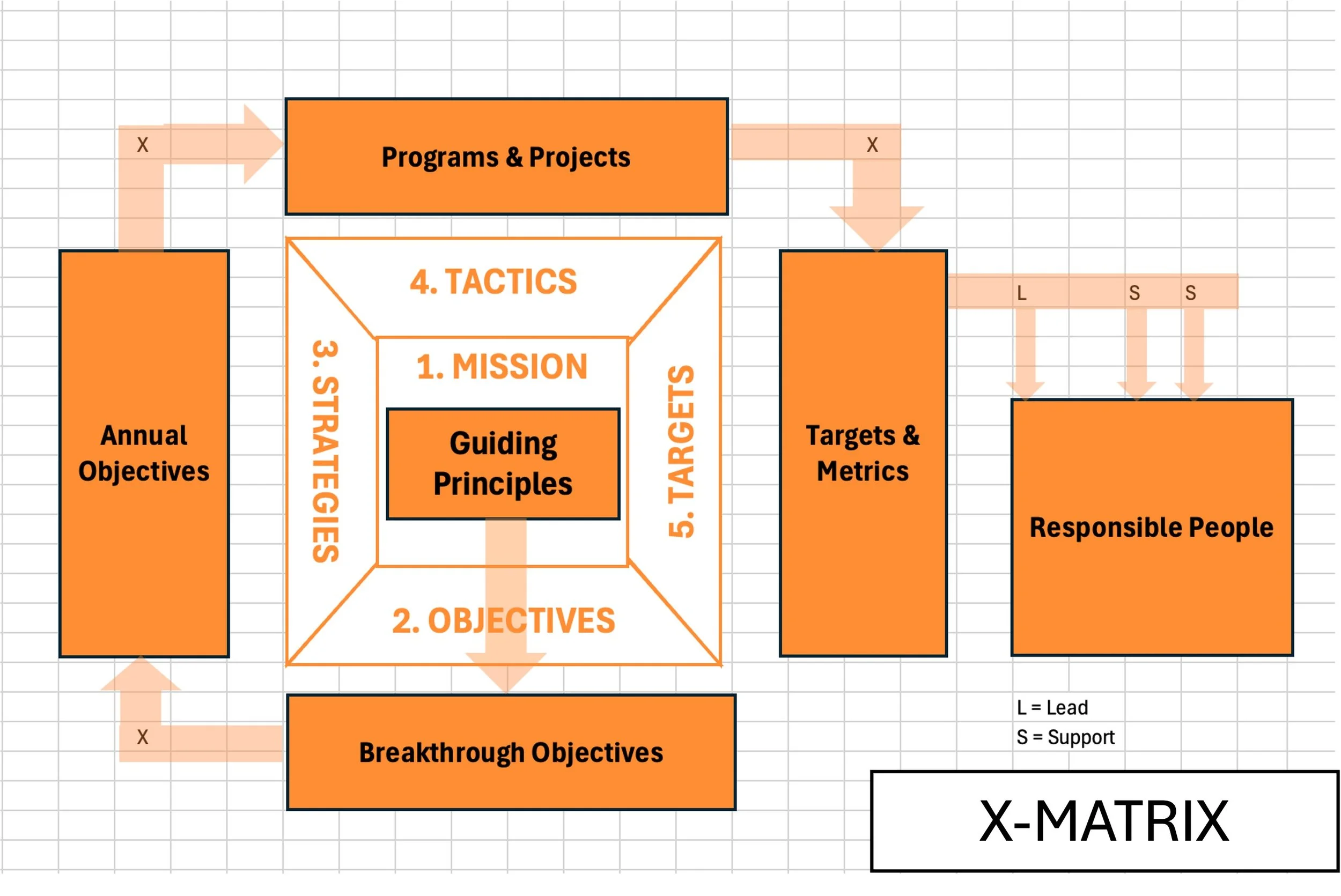
Policy Deployment (Hoshin Karni) explained
Policy deployment is a management discipline designed to translate strategy into execution and to create accountability around clearly defined objectives over a specific period of time.
Longer-term goals are first distilled into a small number of true breakthrough objectives—the priorities that will most meaningfully move the organization forward. These are then translated into annual objectives that define what must be accomplished in the near term to stay on course.
Each objective is supported by a focused set of initiatives—programs or projects that directly enable success. Those initiatives are assigned clear ownership, with accountable leaders and supporting teams responsible for delivery. Progress is made visible through a limited set of performance indicators, allowing teams to track results, identify gaps, and take corrective action as needed.
In a cross-border integration context, the value of policy deployment lies in its ability to align the organization without forcing uniformity. Cultural differences are addressed through thoughtful communication and a well-defined management cadence, while shared objectives and transparent accountability ensure that teams across regions are working toward the same outcomes.

Bowler Diagram explained
The bowler diagram is a key execution companion to the X-Matrix in Hoshin Kanri. While the X-Matrix shows how strategic objectives, initiatives, metrics, and owners are aligned, the bowler shows how those objectives are actually performing over time. It translates strategy into a simple, visual performance scoreboard—typically organized by objective, KPI, target, and time periods (monthly or quarterly)—so leaders can quickly see whether results are on track, at risk, or off track.
More importantly, the bowler diagram is not just about reporting results; it is a management and learning tool. When performance misses the target, the bowler makes gaps visible and prompts discussion about root causes and countermeasures. This reinforces PDCA (plan-do-check-act) thinking and accountability, ensuring that strategy does not stay static on the X-Matrix but is actively reviewed, adjusted, and improved through regular dialogue. Together, the X-Matrix and the bowler diagram connect strategic intent with disciplined follow-up, keeping policy deployment alive in daily management. This tool further reinforces the organizational alignment, particularly important in cross-border integration.